Home >
Oversized & Out-of-Gauge Cargo Shipping >
Special Freight Transportation From China to the USA and Europe (Oversized, Overweight & Out-of-Gauge Cargo Shipping Solutions)
1 / 5
Special Freight Transportation From China to the USA and Europe (Oversized, Overweight & Out-of-Gauge Cargo Shipping Solutions)
We are a professional freight forwarding company specializing in heavy and oversized cargo transportation. We have extensive experience in handling overweight and oversized shipments, and we can operate shipments to various destinations across the USA and Europe.
Requirements and Costs for Heavy and Oversized Cargo Transportation
Route Planning
Transportation routes must consider obstacles such as bridge height limits, road load capacity restrictions, and tight turning points.
Permits and Regulations
Oversized cargo transportation usually requires special permits and must comply with local and national transportation regulations.
Safety Measures
Additional securing measures are required to prevent cargo movement or damage during transit.
Specialized Equipment
Custom transport vehicles, lifting, and handling equipment may be required.
Cost
Due to special equipment and detailed planning requirements, the cost of heavy cargo transportation is relatively high.
Additional Costs in Heavy Cargo Ocean Freight
Including:
Heavy Lift Charge (HLC, charged by shipping lines)
Port overweight storage fees
Loading/unloading crane fees at origin and destination ports
Reinforcement material costs
Note: Total additional costs typically account for 30%–50% of ocean freight charges.
Special Requirements for Heavy Cargo Ocean Shipping
For cargo weighing ≥3,000 kg per item, additional rules apply for booking, loading, and port handling:
Reinforced packaging: Heavy-duty wooden crates or steel frames with forklift slots at the bottom are required. Standard pallets may collapse.
Declared unit weight: Each item’s gross weight must be declared during booking. Underreporting may result in fines of USD 2,000–5,000 per container.
Port storage handling: Oversized containers must be placed in designated port areas, and demurrage fees are 1.5 times higher than standard containers.
U.S. inland transport: Requires heavy flatbed trucks or lowboy trailers, with freight costs 2–3 times higher than standard trucking.
Reminder: Never stack multiple heavy items. Each item must be independently secured; otherwise, additional unpacking and handling fees will apply.
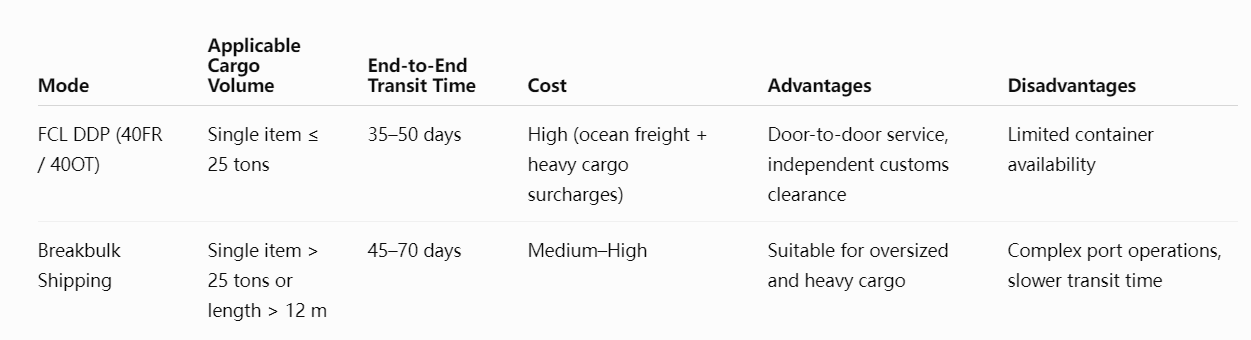
Shipping Methods: FCL Heavy Cargo vs Breakbulk Shipping
Heavy cargo is usually not shipped via LCL. The two main methods are:
FCL DDP (Full Container Load Delivery Duty Paid)
Breakbulk shipping
FCL DDP is the preferred option for most heavy cargo. We typically book 40FR (flat rack) or 40OT (open top) containers. Heavy-duty forklifts or cranes are used for loading at the origin port, and cargo is securely lashed and fixed.
At the destination port, heavy-duty trucks and forklifts must be pre-arranged to transport the full container directly to the construction site for unpacking.
Cost-Saving Tips
Use self-prepared heavy-duty packaging to avoid repackaging fees at ports
Conduct HS code classification in advance to avoid tax adjustments due to incorrect coding
Choose West Coast U.S. ports for clearance to avoid high inland rail transport costs to the East Coast
Delivery Solutions for Oversized Cargo
Heavy cargo is typically delivered to factories, construction sites, or warehouses:
Requires flatbed trucks or lowboy trailers, often with onboard cranes or forklifts
Delivery sites usually require 24-hour advance booking and confirmation of road load capacity and height restrictions
If the receiver has no unloading equipment, mobile cranes may be arranged (USD 200–400/hour)
Our solution: After arrival at port, containers are first moved to a partner heavy cargo yard for unpacking, then delivered via flatbed trucks. Our U.S. heavy transport network covers remote areas and provides “self-unloading” services.
Recommendation: We recommend including “door-to-door with unloading” in contracts to avoid disputes.
Frequently Asked Questions (FAQ)
Q1: What infrastructure details must be considered for oversized cargo route planning?
Transportation routes must be meticulously planned to account for physical obstacles, including bridge height limits, road load capacity restrictions, and tight turning angles that could block large transport vehicles.
Q2: Why are heavy cargo ocean freight costs higher than standard shipments?
Heavy cargo requires special handling and equipment. Additional fees typically include Heavy Lift Charges (HLC) from shipping lines, port overweight storage fees, loading/unloading crane services at both ports, and specialized reinforcement materials. These fees can add up to 30%–50% of the base ocean freight cost.
Q3: What packaging is required for shipping cargo over 3,000 kg?
Heavy items must use reinforced packaging, such as heavy-duty wooden crates or steel frames equipped with forklift slots at the base. Standard pallets are not sufficient and may collapse under the weight.
Q4: What are the consequences of underreporting the weight of heavy cargo?
Each item's gross weight must be accurately declared during the booking process. Underreporting cargo weight can result in severe port and carrier penalties, ranging from USD 2,000 to USD 5,000 per container.
Q5: Which container types are preferred for FCL heavy cargo shipping?
For Full Container Load (FCL) shipping of heavy goods, special container types like 40-foot Flat Rack (40FR) or 40-foot Open Top (40OT) containers are typically used to facilitate top or side loading using cranes.
Q6: What is the recommended delivery arrangement to avoid onsite disputes?
It is highly recommended to explicitly include "door-to-door with unloading" in your freight contracts. Because receivers often lack heavy-duty unloading gear, coordinating mobile cranes or self-unloading services beforehand prevents unexpected delays and costs.
 Changi Logistics